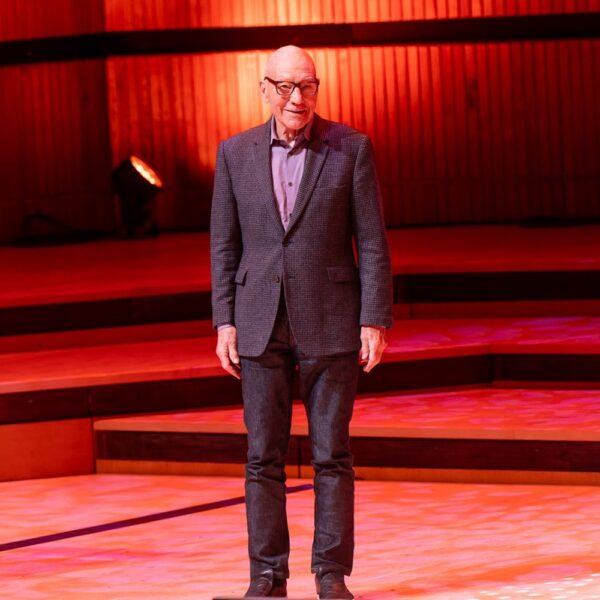
Sir Patrick Stewart, the British actor whose commanding voice and remarkable screen presence made him one of the most recognisable performers of his generation, has died aged 86.
Stewart died at his Los Angeles home on Wednesday, 28 October 2026. His family announced his death the following day, confirming that he had been living with Alzheimer’s disease and Lewy body dementia, according to ITV News, which reported the family’s statement.
His wife, singer-songwriter Sunny Ozell, had been caring for him. In their statement, the family described his final days as a time surrounded by loved ones, music and reflection.
The news brings to an end a career that stretched from the theatres of Britain to two of the most successful franchises in entertainment history. For millions of viewers, Stewart will always be Captain Jean-Luc Picard in Star Trek or Professor Charles Xavier in the X-Men films.
Yet those roles represented only part of his achievement. Long before Hollywood discovered him, Stewart had established himself as a formidable Shakespearean actor, and he remained deeply committed to the theatre throughout his life.
From Yorkshire to the Royal Shakespeare Company
Patrick Stewart was born in Mirfield, West Yorkshire, on 13 July 1940. His childhood was far removed from the comfortable surroundings in which audiences would later encounter some of his best-known characters.
His family had little money, and his home life was troubled by his father’s alcoholism and violence towards his mother.
Stewart would later speak openly about those experiences, explaining how acting offered an escape from a difficult childhood.
His interest in performing developed at school, where teachers encouraged his enthusiasm for Shakespeare. After working briefly as a newspaper reporter, he decided that acting would become his profession.
He trained at the Bristol Old Vic Theatre School before joining the Royal Shakespeare Company in the 1960s.
There he spent years developing the discipline and technical assurance that would become trademarks of his performances. As Reuters recalled in its account of Stewart’s life and career, his success in Hollywood came after decades of work in classical theatre.
His theatre work encompassed some of Shakespeare’s most demanding roles, including Macbeth, King Lear and Claudius in Hamlet.
He was an actor who could command a stage without appearing to demand attention. His distinctive voice was certainly an advantage, but his authority came from a combination of intelligence, restraint and an instinctive understanding of the characters he portrayed.
It was a foundation that would serve him particularly well when American television came calling.
The unexpected journey to Star Trek
Stewart was 47 when he was cast as Captain Jean-Luc Picard in Star Trek: The Next Generation, which premiered in 1987.
At the time, William Shatner’s Captain James T. Kirk remained the defining face of the franchise. Replacing such a familiar figure with an older, relatively unknown British Shakespearean actor was a considerable gamble.
It proved inspired.
Picard was markedly different from Kirk. He was thoughtful, diplomatic and sometimes emotionally guarded. Where Kirk might respond to a crisis with instinct and bravado, Picard preferred discussion, reason and an appreciation of the consequences.
Stewart made those qualities compelling rather than dull.
His Picard possessed authority without constantly having to demonstrate it. He could be severe, occasionally impatient and capable of making mistakes, yet the character’s belief in decency and the possibility of progress gave the series much of its moral identity.
Under Stewart’s leadership, The Next Generation became a huge success, running for seven seasons until 1994.
The character subsequently appeared in films including Star Trek Generations, Star Trek: First Contact, Star Trek: Insurrection and Star Trek: Nemesis.
Decades later, Stewart returned to the role in Star Trek: Picard, which ran from 2020 to 2023.
That final television series gave him the opportunity to explore Picard as an older man, facing regret, loss and the consequences of choices made over a lifetime.
It was an unusual opportunity for an actor: to revisit a character over several decades and allow him to age alongside the person playing him.
Patrick Stewart reflects on his remarkable career
In this conversation recorded at London’s Royal Festival Hall in October 2023, Stewart discusses his Yorkshire childhood, his love of Shakespeare and the unexpected journey that led him to become Captain Jean-Luc Picard.
Speaking to journalist Samira Ahmed at the Southbank Centre’s London Literature Festival, he reflects on more than six decades of acting, sharing stories from the theatre, film and television. The interview accompanied the publication of his memoir, Making It So.
The full conversation is also available through the Southbank Centre’s official website.
Professor Xavier and the X-Men
If Star Trek made Stewart an international television star, the X-Men films introduced him to another generation of cinema audiences.
He first appeared as Professor Charles Xavier in Bryan Singer’s X-Men in 2000.
The character was another natural fit. Xavier was a teacher, a mentor and a man whose belief in coexistence was continually tested by prejudice and violence.
Stewart brought warmth and dignity to the role, making Professor X something more interesting than a convenient source of wisdom for younger superheroes.
He also developed an effective screen partnership with Ian McKellen, whose Magneto represented a profoundly different response to the discrimination faced by mutants.
Their scenes were often among the strongest in the films. Two experienced classical actors could communicate years of friendship, disagreement and mutual respect through relatively little dialogue.
The relationship between Stewart and McKellen extended well beyond the screen. The two became close friends and subsequently appeared together on stage, including in productions of Samuel Beckett’s Waiting for Godot and Harold Pinter’s No Man’s Land.
Stewart returned as Xavier in several further films, but his performance in James Mangold’s Logan (2017) deserves particular attention.
Set in a bleak future, the film presented an elderly Professor X whose formidable mental abilities had become increasingly difficult to control.
It was a moving departure from the wise and assured mentor audiences had come to expect.
Stewart portrayed Xavier’s vulnerability, confusion and frustration without sacrificing the character’s humanity. His scenes with Hugh Jackman’s Wolverine gave the film much of its emotional force.
For all the spectacle associated with superhero cinema, Logan demonstrated how powerful the genre could become when it allowed its characters to confront ageing, illness and mortality.
Much more than two famous characters
Although Picard and Xavier dominated his international reputation, Stewart’s screen career was considerably more varied.
His earlier films included John Boorman’s Excalibur (1981) and David Lynch’s Dune (1984).
He appeared in the thriller Conspiracy Theory (1997), opposite Mel Gibson and Julia Roberts, and took on darker material in films including Green Room (2015).
He was equally willing to make fun of his imposing reputation.
His appearance as an exaggerated version of himself in Ricky Gervais and Stephen Merchant’s Extras was particularly memorable, revealing a comic confidence that contrasted delightfully with his more serious roles.
His voice also became familiar through animation, video games and numerous television appearances, including his long-running portrayal of Avery Bullock in American Dad!.
What linked such different performances was Stewart’s willingness to commit fully to the material. He never appeared embarrassed by science fiction, fantasy or comedy, even when his classical background might have encouraged a more dismissive attitude.
That openness helped make him accessible to audiences who might never have encountered his Shakespearean work.
An actor who used his public standing
Stewart’s achievements were not confined to entertainment.
He became a prominent campaigner against domestic violence, drawing on his own experiences of growing up in a household where his father abused his mother.
He supported organisations working to protect women and children and spoke publicly about the responsibility of men to challenge violence.
In 2024, he was among the public figures who supported The Independent’s Brick by Brick campaign with Refuge, which aimed to provide safe accommodation for women and children escaping abuse.
He was also a supporter of military veterans and people affected by post-traumatic stress disorder, recognising the difficult experiences faced by former service personnel.
Stewart was knighted by Queen Elizabeth II in 2010 for services to drama, a recognition of his contribution to British theatre and the performing arts.
Despite spending much of his later life in the United States, he retained a strong connection to Yorkshire and frequently spoke with affection about his upbringing and the opportunities that education and theatre had given him.
Colleagues remember a remarkable performer
Tributes began arriving from across the entertainment industry following the announcement of Stewart’s death.
Hugh Jackman, who worked alongside him throughout the X-Men series, remembered him as an exceptional actor, a friend and a teacher.
William Shatner, George Takei and other members of the wider Star Trek family also paid tribute to a performer whose interpretation of Picard had helped shape the franchise for nearly four decades.
Marvel Studios praised his contribution to the X-Men films and the humanity he brought to Professor Xavier.
The tributes, reported by Associated Press, reflected the extraordinary breadth of his influence across theatre, television and cinema.
His death has also prompted renewed appreciation of the work that preceded his Hollywood fame.
For younger audiences, he may have been a science-fiction captain or a superhero mentor. For others, he remained one of Britain’s finest classical actors.
Both assessments are justified.
His final performances and public appearances
Stewart continued working well into his eighties. Among his later screen credits were the animated mystery The Sheep Detectives, released in 2026, in which he voiced Sir Ritchfield, and the television comedy Bait.
Audiences will also have another opportunity to see him as Professor Charles Xavier. Stewart returns to the character in Marvel’s Avengers: Doomsday, scheduled for release in December 2026, alongside his longtime friend Ian McKellen as Magneto.
The film is expected to be his final live-action screen appearance, giving his portrayal of Professor X one last chapter more than a quarter of a century after he first played the character.
One of his last prominent stage productions was Harold Pinter’s No Man’s Land in 2016, when he appeared opposite McKellen in a revival that played London’s West End.
Stewart’s last widely reported in-person public appearance came on 9 November 2024, when he attended Huddersfield Town’s match against Crawley Town. A lifelong supporter of the Yorkshire club, he had followed its fortunes since childhood, and People magazine identified the match as his final known public outing.
He nevertheless remained publicly active through recorded appearances. In April and May 2026, he shared videos discussing his recordings of Shakespeare’s 154 sonnets, returning to the work of the playwright who had shaped his early career.
As The Independent reported, the recordings showed Stewart discussing his enduring affection for Shakespeare and the emotions expressed through the poems.
It was a fitting late project for an actor whose professional life had begun with Shakespeare more than six decades earlier.
A legacy beyond the final frontier
There is a temptation, when remembering an actor so closely associated with famous characters, to reduce an entire career to a handful of familiar performances.
Stewart’s career deserves a broader assessment.
He belonged to a generation of British performers who brought classical theatrical training to popular film and television without treating either medium as inferior.
He understood that a science-fiction story could examine power, prejudice, responsibility and the complicated nature of human relationships just as effectively as a Shakespearean tragedy.
That understanding was central to his portrayal of Jean-Luc Picard. The character’s belief that humanity could become wiser, fairer and more compassionate was never presented as an easy certainty. It was something worth defending, even when circumstances made it difficult.
Professor Xavier expressed a similar hope through a very different fictional world.
Stewart gave both characters conviction, but also doubt. Their authority was credible because audiences could see the humanity beneath it.
Few actors have enjoyed such long careers while remaining relevant to successive generations. Stewart managed it without abandoning the theatre that first gave him his direction.
He leaves behind an extraordinary body of work, from Shakespeare to science fiction, from serious drama to comedy.
And although Captain Picard and Professor Xavier will inevitably dominate the tributes, Sir Patrick Stewart should be remembered for something greater: a lifetime devoted to acting, performed with intelligence, warmth and a remarkable respect for his audience.